

If you spend time in Meta Events Manager, you’ve seen the Event Match Quality (EMQ) score. Every event you send through the Conversions API gets a score out of 10. Here’s the question, say your event comes in at 6.9 EMQ. Does that mean Meta matched 6.9 out of every 10 events to a real person on Facebook or Instagram?
That’s what the name would lead you to believe, but it turns out that isn’t what the score actually is. From what we’ve seen, EMQ mostly reflects how many customer details you send with each event, not whether they’re real, which means it can be gamed. Here’s what we found by creating test pixels and sending in fake data.
What does Meta say EMQ scores are?
Meta describes EMQ as a score for how useful the customer information on your events could be for matching them to Meta accounts. Matching is critical because it helps Meta understand how interaction with your ads drives purchases, and it also informs optimizations. Customer information means things like an email, a phone number, an IP address, or the click ID from Meta’s links (fbc).
According to Meta’s developer docs, the EMQ score is calculated from three things: which customer information parameters you send, “the quality of the information received” and the percent of events that are matched to a Meta account. Meta’s own API calls the number a composite_score. However, from what we’ve seen, the percentage of events that are matched to a Meta account really doesn’t seem to factor in.
For the sake of completeness, here are the customer information parameters you can send with an event, along with their priority according to Meta:
| Parameter | Meta’s name for it | Meta’s priority |
|---|---|---|
em | High | |
| Click ID | fbc | High |
| Phone number | ph | Medium |
| Birthdate | db | Medium |
| Facebook Login ID | fb_login_id | Medium |
| External ID (your own customer ID) | external_id | Medium |
| Browser ID | fbp | Medium |
| Country | country | Medium |
| First name | fn | Low |
| Last name | ln | Low |
| City | ct | Low |
| ZIP or postal code | zp | Low |
| State | st | Not listed |
| Gender | ge | Not listed |
| IP address | client_ip_address | Not listed |
| User agent | client_user_agent | Not listed |
Meta’s priority table leaves out IP address and user agent, but its developer docs say the user agent is required for website events, and that sending both may help matching.
We tested gaming EMQ scores by sending in fake data and broke some TOS. Whoops.
If the EMQ score really is a measure of how many people Meta was able to match based on the events you sent in, then fake data should score terribly. But it doesn’t. We set up some test pixels and sent them events through the Conversions API with data that couldn’t have possibly been correct for anyone:
| Parameter | What we sent |
|---|---|
| Incorrect emails | |
| IP address | Incorrect IPs |
Click ID (fbc) | Click IDs that would never match a click |
| Address | Completely fake addresses |
| Birthdate | Birthdays that didn’t make sense |
| Facebook Login ID | Login IDs that didn’t make sense |
Somehow we were still able to push scores well above 9 for initiate checkout and purchase. Here’s one of those test pixels, with nothing but fake data in it. The purchases came in at 9.6 out of 10, and the checkouts at 9.3.
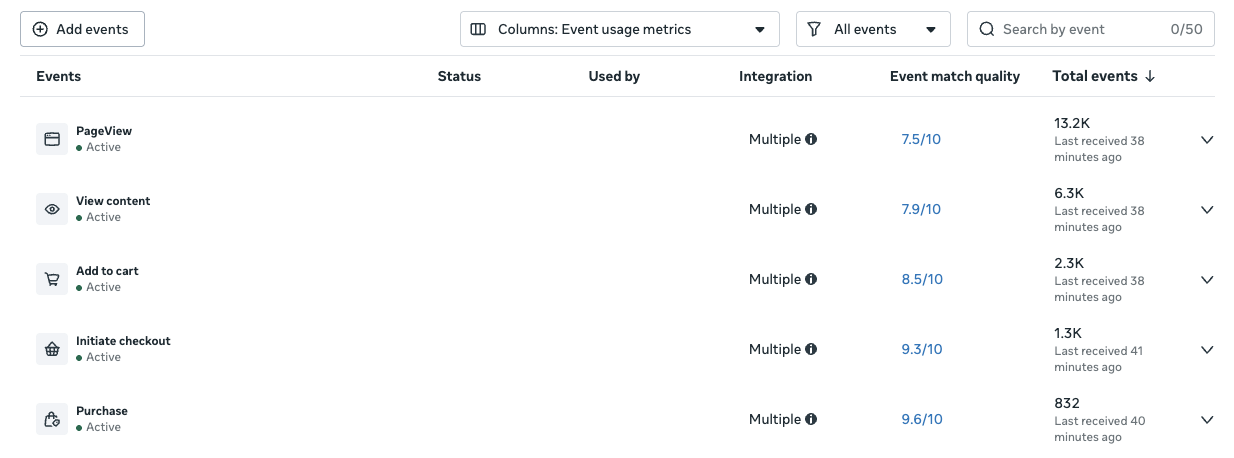
It’s pretty clear that EMQ isn’t judging how many Facebook users out of 10 are being matched. It’s judging how many parameters you send with each event, and the quality of those parameters may not be judged at all.
To be fair, Meta has started catching the laziest version of this. If you’re sending in placeholder IP addresses like 0.0.0.0, or the same placeholder email or phone number on lots of events, Meta’s EMQ diagnostics will flag it. But those flags don’t show up in Events Manager. You have to pull them from Meta’s API to see them, and most people won’t do that. And a fake email that’s different on every event isn’t a placeholder anyway.
Is a perfect 10 EMQ score a possibility on purchase?
We’ve been reviewing tons of Meta accounts lately, looking at EMQ scores and trying to understand what factors push them high. And we ran into this extreme example of a 10 out of 10 purchase, which we’d never seen before.
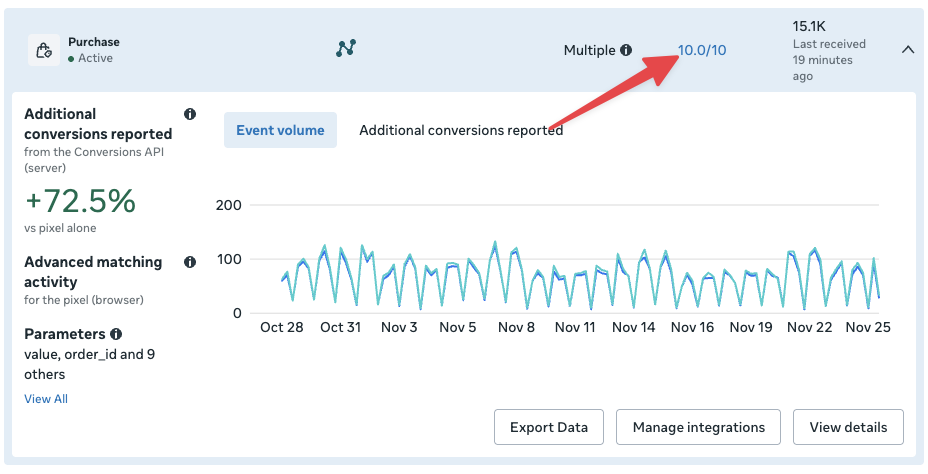
It’s a 10 because the vendor behind the integration is sending a Facebook Login ID with every single purchase. Meta’s Help Center lists Facebook Login ID as a medium-priority parameter, in the same group as phone number and birthdate, so it counts toward the score.
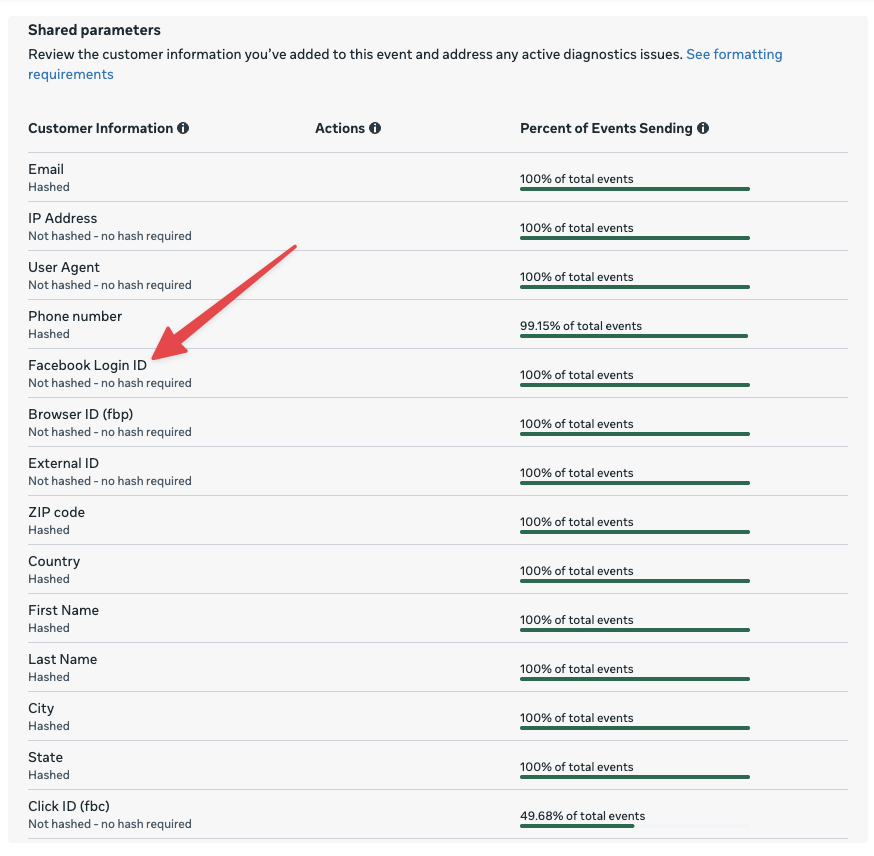
The trouble is that a normal online store doesn’t have them. A Facebook Login ID is the ID Meta issues when someone logs in to an app with Facebook (Meta also calls it an app-scoped ID). The only way to get one is if people log in to your site or app with Facebook. In a regular checkout, there’s nowhere for it to come from. And even on a store that does offer Facebook login, you wouldn’t expect every single buyer to use it.
If the Facebook Login ID wasn’t on this particular purchase event, and its coverage was 0% like it should be if they were being honest, this would probably rank somewhere between a 9.1 and a 9.3. But the Facebook Login ID pushes it to a 10, even though it’s made up, fake, and just used to pad the data.
So the best score we’ve ever seen is built on data that store has no way of collecting from its own shoppers.
Why is gaming the EMQ score a big deal? Does it even matter?
Meta’s docs say only matched events can be used for attribution and ad delivery optimization. Matching is the whole point. And as far as we can tell, the score can’t tell you whether it’s happening.
In theory, you could have a 10 on every event and none of them matched to a real person. That would be terrible for your Meta performance, and nothing in Events Manager would look wrong. It also means your EMQ and your ad results don’t have to line up. A vendor with a higher score isn’t necessarily sending better data.
Don’t get us wrong, we look at EMQ all the time, and we’ve used it to compare one setup against another. When the data is honest, it’s a reasonable proxy for signal quality. The score just can’t tell you whether the data is honest. So you need to be aware if you see event scores that seem unusually high.
If you see an unusually high EMQ score, ask for proof
EMQ isn’t the end-all and be-all. If a score looks too good, or a vendor is selling you on theirs, ask them to show you what’s actually in the events. For example, if your purchases carry a Facebook Login ID and your store doesn’t have Facebook login, ask your Meta Conversions API (CAPI) vendor where it’s coming from. Every email, phone number and address should trace back to something a customer gave you on your site. IP addresses should be your visitors’, not your server’s. And anything your site has no way of collecting shouldn’t be there at all.
So here’s the bottom line. Event Match Quality doesn’t mean how many of your events Meta can match, or how likely it is to match the data you’re sending in. As far as we can tell, it’s simply a score of the fill rate of the parameters you send with each event (how many of them are filled in), and it has no real connection to whether that data is accurate. That’s why it can be gamed.
Keep in the back of your head that these scores can be gamed. And yes, your highly reputable vendor probably isn’t doing it, but if you see something unusual, it should raise an alarm rather than applause.
What is Event Match Quality (EMQ) in Meta?
It’s a score out of 10 in Events Manager for website events sent through the Conversions API. Meta says it shows how useful the customer information on your events could be for matching them to Meta accounts.
How is the EMQ score calculated?
Meta says it looks at which customer information parameters you send, the quality of that information and the percent of events matched to a Meta account. It doesn’t publish how much each one counts. In our tests, how many parameters you send seemed to matter most, since fake data still scored above 9.
Where do I find my EMQ score?
In Meta Events Manager, open your dataset (your pixel). Each event in the overview shows its Event match quality as a score out of 10, and you can click into an event to see which customer information parameters you’re sending and on what share of events.
Does an EMQ score of 6.9 mean 69% of my events matched?
No. Meta’s API calls it a composite score. Meta says the share of events matched to accounts is one input, mixed with which parameters you send and their quality, and it doesn’t publish how they’re weighted.
Can fake data raise my EMQ score?
In our tests, yes. A test pixel sent nothing but fake data (incorrect emails and IPs, fake addresses and click IDs that could never match) and its purchases scored 9.6 out of 10. Meta’s diagnostics do flag obvious placeholders, like a 0.0.0.0 IP address or the same placeholder email on lots of events, but only through its API, not in Events Manager.
What EMQ score on purchases is too good to be true?
In our experience, if your site doesn’t have Facebook login and your purchase EMQ is above 9.3, something’s probably wrong with the data being sent. Ask your vendor to show you where every parameter comes from.
What is a Facebook Login ID?
It’s the ID Meta issues when someone logs in to an app with Facebook, also called an app-scoped ID. A store only has them if people log in to its site or app with Facebook, so most online stores can’t send one.
Is a higher EMQ score always better?
Only if the data behind it is real. Meta can only use matched events to credit sales to your ads and optimize delivery, and a score padded with data that doesn’t match anyone won’t help with either.
How do I raise my EMQ score without gaming it?
Send the customer information you actually collect, on as many events as you can. Meta rates email and the click ID as its high-priority parameters, and says sending the visitor’s real IP address and user agent may help matching. Don’t send anything your site didn’t collect.
How can I check what my Conversions API integration is sending?
Pick a few real orders and ask your vendor for the events they sent Meta for them, with the values before hashing. Every field should match what the customer gave you on your site.